Pressroom
Welcome to the Press Centre of ATP architects engineers. Here you can find and download current press information and other basic information about our company.
All contents of this message as .zip:
Rethinking Church Spaces
How Historic Churches Become Vibrant Meeting Places

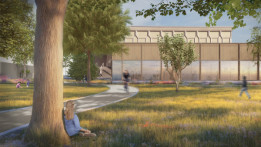
Credits: © ATP architekten ingenieure
Press Release (5796 character)
Many parishes are facing major financial and structural challenges. At the same time, they represent a unique cultural heritage and remain important places of community. Their adaptive reuse calls for particular planning sensitivity and integrated expertise. A remarkable example is the Petrus Canisius parish church in Innsbruck, which will soon bring new energy to the existing building as a vibrant climbing and community space
Church interiors are among the most defining spaces of public life – and yet many now stand empty. Declining attendance and shifting societal needs are bringing numerous sacred buildings to a turning point. Their adaptive reuse therefore presents a unique task for planners: it requires responsibility, sensitivity, and new answers.
“In Austria, the adaptive reuse of sacred spaces has so far been rarely tested. This intensifies legal, heritage conservation, and societal challenges.” – Florian Anschober, Architect at ATP in Innsbruck
Sacred buildings often no longer meet today’s requirements for Building Services, fire protection, or accessibility. At the same time, beyond their material value, they carry deeply rooted religious and symbolic meaning. Interventions are therefore assessed not only from a structural perspective, but also in cultural and ethical terms – and demand a sensitive dialogue between the Church, heritage authorities, the public, and architecture.
The Power Of Space
Precisely because sacred buildings possess extraordinary spatial qualities, uses that actively bring this generosity to life are particularly suitable. Large spans, controlled daylight, vertical spatial impact, and clear geometry give church interiors their distinctive atmosphere. Yet these very characteristics respond sensitively to technical interventions. Change is only compatible up to the point where spatial impact, proportions, and the lighting concept remain legible.
But which functions can activate the space without overpowering it? Not every use is suited to a church. Sports, cultural, or assembly uses work well because they can be organized as freestanding elements. They allow the space to be experienced as a whole. What is crucial is that they can be realized with reasonable, reversible interventions.
“Good architecture becomes tangible where it does not displace, but supports.” – Florian Anschober, Architect at ATP in Innsbruck
Complement Rather Than Compete
Dealing with the symbolic significance of such spaces requires above all restraint, legibility, and dialogue. New uses must remain recognizable as contemporary additions and must not attempt to imitate or override the sacred expression. New functions can be integrated without competing with the existing architecture by designing new elements as structurally independent, clearly organized, and formally reduced. Freestanding, additive installations respect the existing fabric and allow the historic architecture to remain defining.
Reversible or minimally invasive interventions are essential. Requirements and uses may change again in the future. All measures must therefore be designed to be dismantled and to preserve the substance as far as possible. Reversibility creates both acceptance from heritage authorities and long–term flexibility.
Activating The Existing Fabric: Church As Climbing Space
The Petrus Canisius parish church is a successful example of the further development of a church interior. The key to success lay in integrated design from the outset – in the interplay of architecture, Building Services, electrical engineering, and structural design. Only in this way could a solution be developed that equally addresses the requirements of the Church, the city, heritage authorities, and the public.
“The project is of exceptional interest in Austria, as it represents one of the first adaptive reuses of a sacred building of this kind.” – Florian Anschober, Architect at ATP in Innsbruck
Within the church interior, the spatial impact of the sacred building designed by Horst Parson, with its continuous ribbon of light, remains fully intact. The climbing walls hover as a clear, new level above the mats, while the altar remains visible and accessible. The required Building Services are relocated almost invisibly, allowing climbing as a new function to be clearly recognizable without overlaying the sacred space. The ventilation system required for the high air exchange rate is accommodated within the raised attic of a southern annex. Exhaust air is routed back through the ground surrounding the building. The listed existing structure thus remains largely free of service routes and installations.
Here, adaptive reuse does not mean replacing history, but continuing it – with respect for the place, architectural restraint, and a new communal use.
“Architecture remains tangible – even when the space accommodates a new function.” – Florian Anschober, Architect at ATP in Innsbruck
Florian Anschober is an architect at ATP in Innsbruck. He studied architecture at TU Wien and the University of Innsbruck, where he focused, among other topics, on building within existing structures, as well as economic and social sciences at WU Wien. He gained international practical experience at Zaha Hadid Architects as a Venice Studio Fellow, at Powerhouse Company in Rotterdam, and at any:time Architekten.
petrus carnisius kirche axo (.png )
Credits: © ATP architekten ingenieure
| Dimensions | size | ||
|---|---|---|---|
| Original | 4458 x 2868 | 4.65 MB | |
| Medium | 1200 x 772 | 298.84 KB | |
| Small | 600 x 386 | 87.52 KB | |
| Custom | x |
More Images