Pressroom
Welcome to the Press Centre of ATP architects engineers. Here you can find and download current press information and other basic information about our company.
Contract Awarded to ATP
Transformation and Multifunctional Expansion at Rostock Stadtwerke
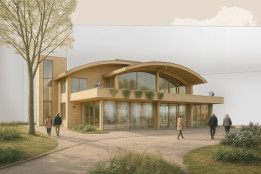
Award in VgV tendering process: The expansion will transform the company canteen of Stadtwerke Rostock into a multifunctional space for catering, exchange, and events. The available spaces will be repurposed as a future-oriented New Work workspace. New and existing areas will be functionally, spatially, and organizationally restructured – all while operations continue.
Rethinking Church Spaces
How Historic Churches Become Vibrant Meeting Places

Many parishes are facing major financial and structural challenges. At the same time, they represent a unique cultural heritage and remain important places of community. Their adaptive reuse calls for particular planning sensitivity and integrated expertise. A remarkable example is the Petrus Canisius parish church in Innsbruck, which will soon bring new energy to the existing building as a vibrant climbing and community space
“Climbing Church” – From Sacred Space to Boulder Hall
Adaptive Reuse of the Parish Church of Petrus Canisius, Innsbruck

An unconventional church concept: The listed parish church of Petrus Canisius is set to host bouldering activities in the future. Our highly sensitive design preserves the sacred interior atmosphere while creating a modern and vibrant space for sport, encounters, and urban life.
Hybrid Timber Office Building
Grand Central, Vienna

The “Grand Central” office building at Vienna’s Floridsdorf Station is a hybrid timber building par excellence, because the building complex had to be built as quickly as possible, due to its extremely busy location. In addition to this, this environmentally-friendly building method was also a game changer in terms of the key structural requirement – that the building had to be as light as possible due to the fact that it is supported by the metro tunnel that passes below it. The elegant role played by the (completely invisible) use of timber in the integrated design of the building with Building Information Modeling (BIM) comes as a particularly pleasant surprise.
ATP Krakow
ATP establishes an integrated design office in Krakow

ATP Asymetria, the Krakow office of ATP architects engineers, is repositioning itself: Following several years of close cooperation with the well-known Polish engineering company Tequm, the offices have now decided to merge in order to be able to provide all architecture and engineering services from a single source under the name ATP Krakow. This will enable the new office to benefit from the synergies offered by the entire ATP Group and to offer a complete range of design services in line with the ATP standard. ATP Krakow is headed by the architects Marek Borkowski and Witold Gilewicz, together with the engineer Marek Dyduch of Tequm.
...
